You love your dog. You also love your yard. The problem is that right now, one of them can’t be in the other without someone standing watch.
Whether you’ve got a 90-pound German Shepherd who treats your backyard like a staging area for escape attempts, a Beagle with an inexhaustible nose and zero road sense, or a pair of Labs who just need room to run, the answer is the same: it’s time for a fence.
The Four States region has its own set of conditions that should factor into your fence decision. Clay soil, humid summers, tornado-season wind events, and the coyotes that roam at dusk are all part of the picture. Choosing the right fence for your dog here isn’t just about what looks good in a brochure. This guide will walk you through everything you need to know to make the right call!
In This Guide:
- Before you choose a fence, know your dog
- The best fencing materials compared for dog owners
- Four states region special considerations for dog owners
- Custom fencing for dog owners with Miller Fence
Before You Choose a Fence, Know Your Dog
The biggest mistake dog owners make when shopping for a fence is starting with the material before they’ve thought about the animal. Before you call anyone, think about which of these three categories describes your dog:
The Jumper: Athletic, high-energy dogs like Border Collies, German Shepherds, Huskies, Dobermans, and Labradors can clear a 4-foot fence without breaking stride. A 6-foot fence is the minimum, and the material should offer no footholds on the inside. Any fence with horizontal rails facing inward is essentially a ladder.
The Digger: Terriers, Beagles, Dachshunds, and Huskies are notorious for digging. The fence you choose needs to account for what happens at the base. A fence that ends cleanly at ground level with nothing below it is an open invitation. The solution is a buried footer, a concrete base, or a dig guard (discuss with your contractor before installation!).
The Reactor: Some dogs are set off by everything: the mail carrier, a squirrel, a neighbor’s dog, a plastic bag. For reactive dogs, a solid privacy panel that completely blocks the sightline to the street is one of the most effective ways to reduce barking and anxiety. An open fence often makes reactivity worse, not better.
Another thing to consider: Especially in the Four States region, a fence that keeps your dog in also needs to be evaluated for whether it keeps coyotes out. For small and medium-sized dogs, a 6-foot fence with a solid base is the minimum we’d recommend.
The Best Fence Materials Compared for Dog Owners
Miller Fence installs every material covered below. Here’s a breakdown of how each one performs for dog owners in our region.
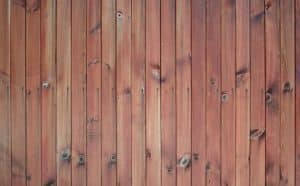
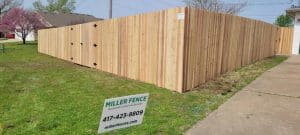
Wooden Privacy Fence
Best for: Barkers and reactive dogs, medium-to-large breeds, homeowners who want privacy and containment.
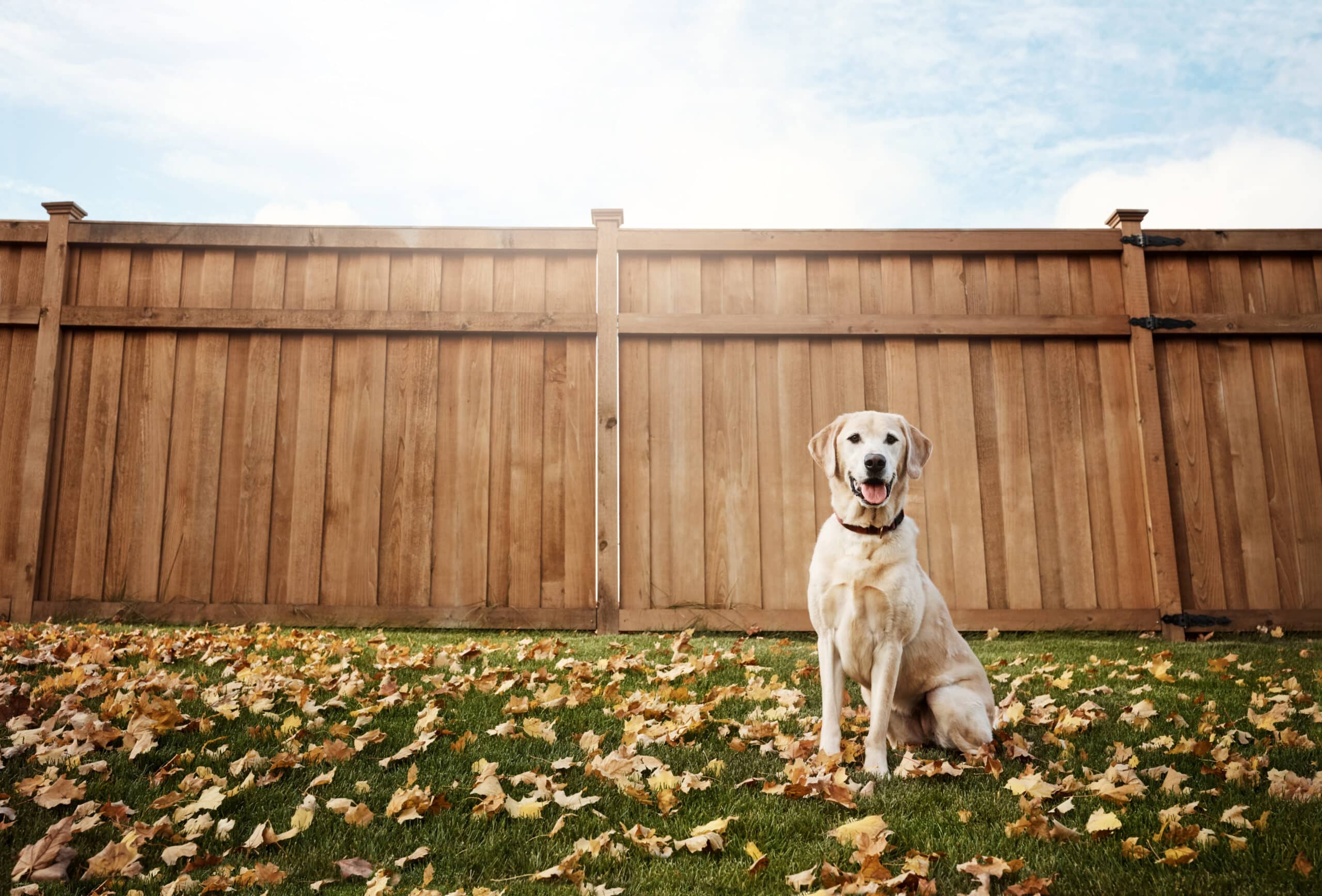
A solid wooden privacy fence is one of the most effective options for dogs because it eliminates the sightline to the street. If your dog goes ballistic every time someone walks past, a 6-foot wood privacy fence can change your dog’s behavior and your quality of life.
Wood is also one of the most customizable materials. Heights, board spacing, and gate placement can all be tailored to your specific yard and your specific dog.
What to watch for in the Four States: Our climate (high humidity, temperature swings from below freezing to over 100°F, and clay soil that holds moisture) is tougher on wood than in other parts of the country. Cedar is the regional champion with natural oils that resist rot and repel termites and carpenter ants, which are common throughout the Four States. A cedar fence, professionally installed with proper post depth and drainage, can last 10–15 years in our climate.
- Height recommendation: 6 ft for most dogs; 5 ft minimum for smaller breeds
- Best against: Barkers, reactors, medium-to-large breeds
- Limitations: Requires maintenance; small dogs may find gaps at the base if the yard has uneven terrain
Learn more about installing a residential wood fence with Miller Fence.
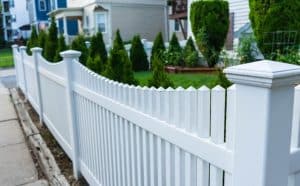
Vinyl Privacy Fence
Best for: Diggers, climbers, low-maintenance households, families with small dogs
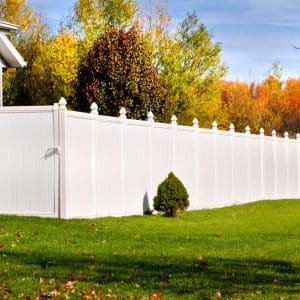
Vinyl’s smooth, solid surface is one of its biggest advantages for dog owners because there are no footholds, no horizontal rails to climb, and no rough texture to grip. For dogs that are talented climbers, vinyl removes almost every option.
For diggers, vinyl performs well when installed with a concrete footer at the base. Unlike wood, vinyl won’t splinter or rot at the ground line over time, so the integrity of the base stays consistent for the life of the fence.
Vinyl is also the easiest material to clean. Muddy paw prints, rain splashes, and the general chaos of an active dog household wipe off vinyl in minutes.
What to watch for in the Four States: Quality matters significantly with vinyl in our climate. Cheap vinyl can become brittle in extreme cold, which is a real concern after the ice storms that hit the region most winters. Miller Fence installs commercial-grade vinyl that’s rated for our temperature range.
- Height recommendation: 6 ft standard
- Best against: Climbers, diggers (with proper footer), reactive dogs
- Limitations: Higher upfront cost than wood; fewer height and style options than wood
Learn more about installing a residential vinyl fence with Miller Fence.
Vinyl Fence
Chain Link Fence
Best for: Large breeds, active dogs, rural properties, budget-conscious homeowners.
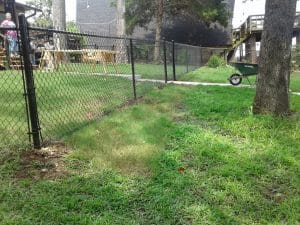
Chain link is the most durable and affordable fencing material we install. It handles the Four States’ heat and humidity exceptionally well, allows airflow during hot summers, and holds up to impact and weather better than any other material at its price point.
The limitation is that the chain link does not block sightlines. If your dog is reactive to movement and sound, a chain link fence may make the problem worse, not better. For those dogs, a privacy option is a better starting point.
Upgrades worth discussing with your fencing contractor:
- Privacy slats woven through the chain link dramatically reduce visual stimulation for reactive dogs without replacing the entire fence.
- A buried footer or concrete base is essential for diggers. Chain link’s biggest vulnerability is at ground level.
What to watch for in the Four States: Chain link installed in clay soil needs proper post-setting to stay upright through freeze-thaw cycles and storm events. This is a place where professional installation matters. Posts that aren’t set deep enough and secured with concrete shift over time.
- Height recommendation: 5–6 ft; 6 ft for athletic large breeds
- Best against: Runners, large active breeds, rural containment
- Limitations: No privacy; not ideal for reactive dogs without slat upgrades; digging vulnerability at base without footer
Learn more about installing a chain link with Miller Fence.
Aluminum or Wrought Iron Fence
Best for: Homeowners who prioritize curb appeal, calmer dogs, front yard applications.
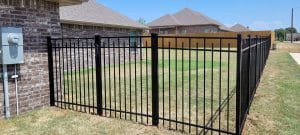
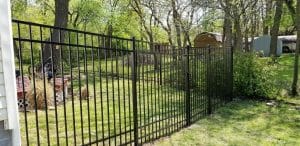
Ornamental metal fencing (aluminum or wrought iron) is the right choice when aesthetics are a major priority and your dog is calm, not athletic, and not a digger. It’s one of the most beautiful fencing options we offer, and it adds significant curb appeal and property value.
Unfortunately, it is not the right primary containment fence for most dogs. The open picket design doesn’t block sightlines, and the gaps between pickets can be a problem for small breeds. An escape-prone dog will find the footholds between rails quickly.
The most effective way to use ornamental metal for dog owners is as a front yard or side yard accent fence, paired with a wood or vinyl privacy fence in the backyard where the dog actually spends time.
- Height recommendation: 4–5 ft for most residential applications
- Best against: Calm, non-athletic dogs; front yard perimeter fencing
- Limitations: Open design not suitable for reactive dogs, small breeds, or escape artists
Learn more about installing an aluminum or iron fence with Miller Fence.
Four States-Specific Considerations Every Dog Owner Should Know
This is where local knowledge matters. A contractor who installs fences across the country can give you a general recommendation. A contractor who installs fences in Joplin, Bentonville, Pittsburg, and Bartlesville every week knows things that don’t show up in a brochure.
Clay soil changes the equation. The Four States region has significant clay soil across much of Southwest Missouri and Northwest Arkansas. Clay holds moisture, expands when wet, and contracts when dry which creates pressure on fence posts over time. Proper post depth and concrete setting is what separates a fence that holds for 15 years from one that starts leaning after the first hard winter.
Storm season is real. Straight-line winds, tornadoes, and severe thunderstorms roll through the Four States every spring and summer. A fence that isn’t properly braced and anchored can fail in a wind event, which is both a property damage issue and a dog containment issue at the worst possible moment.
Heat, humidity, and your fence material. Summers are hot and humid in a way that accelerates certain types of material degradation. Cedar and chain link handle this best. Quality vinyl handles it well when the material grade is right. Material quality, not just material type, matters when you’re getting quotes.
Tick exposure. A fence won’t stop ticks from entering your yard, but it does keep your dog from wandering into the wooded areas where tick exposure is highest. Particularly for properties that back up to tree lines or creek beds, a fence reduces your dog’s tick exposure by keeping them in the maintained yard.
Coyotes are active. Coyotes are present throughout the Four States region, including suburban neighborhoods on the edges of Joplin, Fayetteville, and Springdale. For small and medium-sized dogs, a 6-foot solid fence with a buried base is the minimum we’d recommend. Coyotes can clear a 4-foot fence and will dig under an unanchored base.
Residential Fences with Miller Fence
A fence that’s properly matched to your dog and professionally installed in our region’s soil will give you years of reliable containment and peace of mind. A fence that’s chosen on price alone, without accounting for your dog’s behavior or the local conditions, often ends up costing more in repairs or in a lost dog.
At Miller Fence, we’ve been helping homeowners across Southwest Missouri, Southeast Kansas, Northeast Oklahoma, and Northwest Arkansas figure out exactly this question. We install wood, vinyl, chain link, and ornamental metal, and we’re happy to talk through what makes sense for your yard and your dog before you commit to anything.